

Iran’s leadership crisis is often framed as a question of regime survival, regional war, or nuclear escalation.
That framing misses the point.
For Europe, the primary risks are second-order and indirect — but they are also the most destabilizing:
weaponized migration routes
proxy and criminal networks operating inside EU states
energy-market shocks, and
political spillover that feeds domestic polarization.
The risk snapshot below maps these pressures against a simple question:
where does threat intensity already exceed Europe’s preparedness?
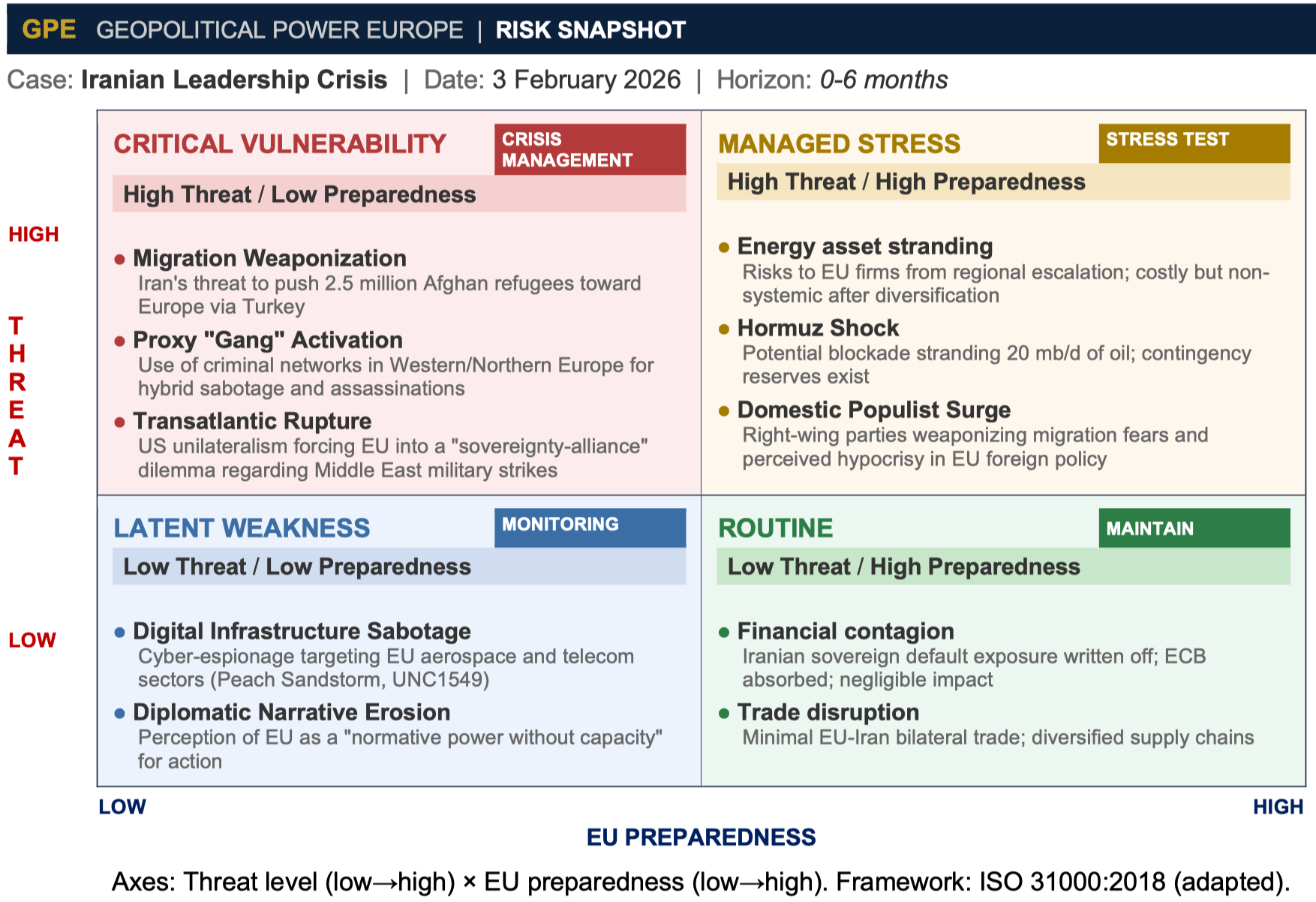
What emerges is an uncomfortable picture.
The EU is relatively well positioned for financial and trade disruption. It is far less prepared for hybrid retaliation, migration coercion, and cascading regional spillovers triggered by escalation involving Israel, Iraq, or the Strait of Hormuz.
This is why the Iran crisis should not be read as a distant Middle Eastern instability. It is a stress test of Europe’s internal security, social cohesion, and geopolitical credibility — especially after the designation of the IRGC and Iran’s retaliatory framing of European armed forces.
The chart highlights the pressure points.
The PDF contains the full assessment: short-term risks (0–6 months), medium-term scenarios (6–18 months), escalation indicators, and what effective European response would actually require.
⬇️ Risk Snapshot below
