KEY POINTS
• The 2026 NDS represents the most significant US strategic reorientation since the Cold War, explicitly designating Europe as a secondary theater requiring “critical but more limited U.S. support.”
The 5% GDP defense spending target (3.5% military + 1.5% security) would require €400–500 billion in additional annual European defense expenditure—a fiscal and political shock.
Critical vulnerability: European strategic autonomy cannot close the capability gap before 2035; the 2026–30 window is peak exposure to Russian opportunism.
Ukraine policy transfer is now explicit: the NDS states Ukraine is “Europe’s responsibility first and foremost,” creating immediate resource and credibility challenges.
Scenario analysis: Base case involves muddled adaptation with persistent capability gaps; worst case risks NATO Article 5 credibility crisis.
1. The Strategy and Its Context
The 2026 National Defense Strategy, released by the newly renamed Department of War on 23 January 2026, represents the most significant US strategic reorientation since the end of the Cold War. For Europe, this is not merely a policy adjustment—it is a structural transformation of the transatlantic security architecture that has underwritten European peace for seven decades.
Three fundamental shifts define the NDS from a European perspective:
First, Europe is explicitly designated a secondary theater. The strategy’s four Lines of Effort prioritize: (1) Homeland/Hemisphere defense, (2) China deterrence in the Indo-Pacific, (3) Burden-sharing with allies, and (4) Defense industrial revitalization. Europe appears only within Line of Effort 3, framed as a region where allies must “take primary responsibility for Europe’s conventional defense, with critical but more limited U.S. support.”
Second, the Russia threat assessment represents a deliberate downgrade. The NDS characterizes Russia as a “persistent but manageable threat” and explicitly notes that “Moscow is in no position to make a bid for European hegemony.” This language—combined with the observation that “Germany’s economy alone dwarfs that of Russia”—signals Washington’s view that Europe possesses the latent capacity to handle its own security.
Third, Ukraine policy transfer is now explicit. The strategy states unambiguously that the war in Ukraine is “Europe’s responsibility first and foremost,” marking an official endpoint to US-led Ukraine support as previously configured.
2. Strategic Risk Assessment
The NDS creates a four-quadrant risk landscape for Europe, organized by threat severity and European preparedness:
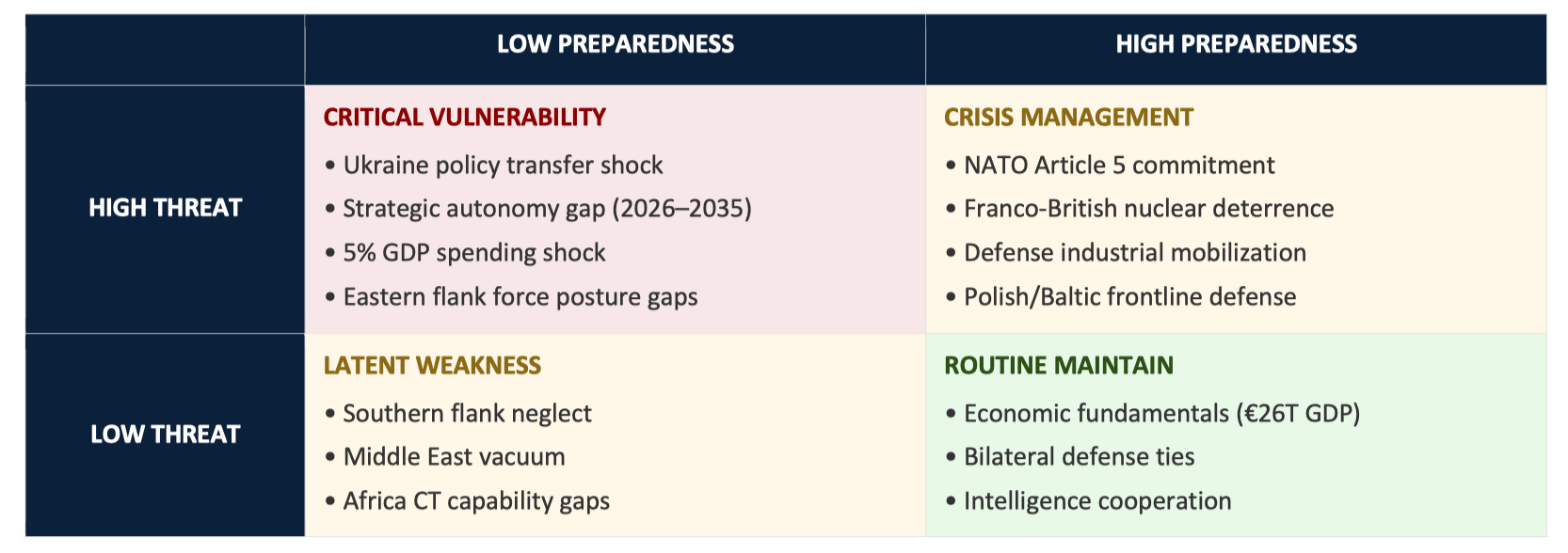
The critical vulnerability quadrant demands immediate attention. The combination of high threat exposure and low preparedness in areas such as Ukraine policy transfer, the strategic autonomy gap, and the 5% GDP spending shock creates systemic risk. European defense spending currently averages 2.1% of GDP; reaching the Hague Summit target would require Germany alone to increase annual defense expenditure by approximately €120 billion—a political impossibility without major fiscal and constitutional changes.
3. Risk Cascade Model
Risks identified in this analysis do not operate in isolation. The NDS creates two interconnected feedback loops that amplify baseline risks:
Transatlantic Loop: Reduced US commitment → European capability gaps → Deterrence degradation → Russian opportunism → Crisis requiring US involvement → Domestic US backlash → Further reduced commitment. This loop suggests that the NDS’s premise—that Europe can seamlessly assume primary responsibility—may be self-undermining if the transition period creates security vacuums.
Intra-European Loop: Spending pressure → Fiscal constraints → Political populism → EU fragmentation → Weakened collective response → Bilateral arrangements with US → Further EU marginalization. This dynamic risks fragmenting European responses precisely when coordination is most needed.
4. Scenario Analysis (18–36 Month Horizon)
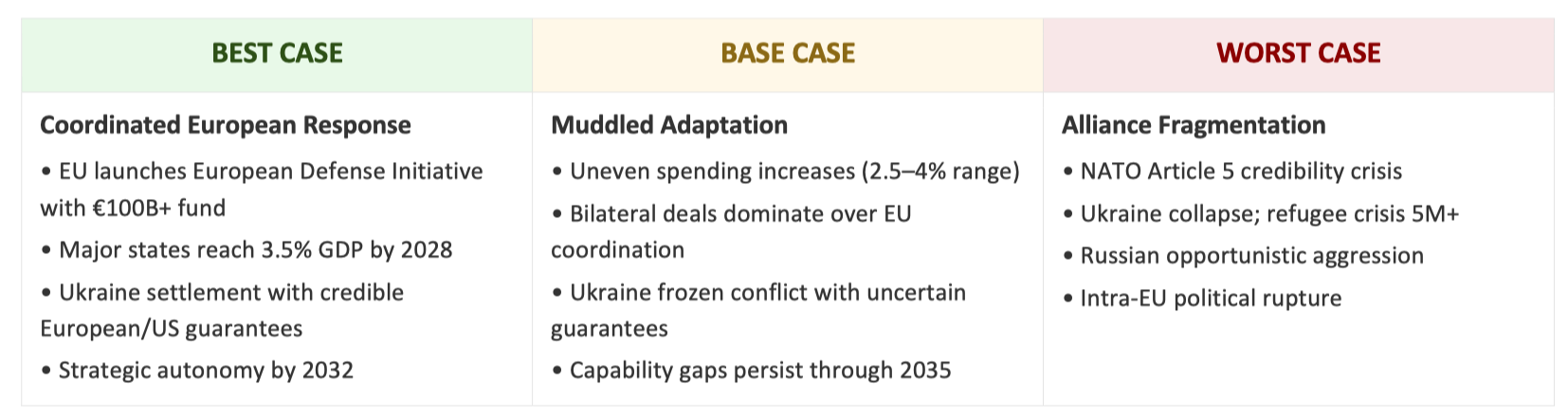
The scenario distribution reflects the structural constraints Europe faces. The best case requires unprecedented political coordination across 27 member states on defense spending, institutional reform, and Ukraine policy—historically difficult even in crisis conditions. The base case represents institutional inertia, while the worst case materializes if any of several plausible triggers occur: Ukrainian military collapse, provocative Russian action against a NATO member, or domestic political upheaval in a major European state undermining defense commitments.
5. What to Watch
The following indicators will signal trajectory direction over the next 6–12 months:

BOTTOM LINE
The 2026 NDS represents a structural shift in US grand strategy that Europe cannot reverse through diplomacy alone. The fundamental premise—that European NATO’s €26 trillion economy dwarfs Russia’s €2 trillion and therefore can assume primary responsibility for continental defense—is economically valid but politically and institutionally premature. The 2026–2030 period represents peak vulnerability: the gap between the withdrawal of US-led security architecture and the maturation of European alternatives. Managing this transition without catastrophic failure requires coordinated action at a pace and scale Europe has rarely demonstrated outside acute crisis. The window for shaping outcomes is measured in months, not years.