

KEY POINTS
The Maduro abduction creates three interconnected challenges for the EU: erosion of legal norms, transatlantic rupture, and cascading geopolitical spillovers.
Critical vulnerabilities—particularly Greenland and rules-based order erosion—require immediate crisis management protocols.
Risks operate as multipliers: geopolitical pressure amplifies intra-EU divisions; fragmentation emboldens further US unilateralism.
1. The Operation and Its Context
On 3 January 2026, US special operations forces conducted an extraterritorial detention of Venezuelan President Nicolás Maduro in Caracas. The operation, justified under a 2020 narco-terrorism indictment, represents the first forcible abduction of a sitting head of state since the US intervention in Panama (1989).
The Trump administration framed the action as enforcement of US law and reassertion of hemispheric primacy—what Secretary Rubio termed the “Donroe Doctrine,” explicitly reviving Monroe-era language of American prerogative in the Western Hemisphere.
The EU’s response has been fragmented. The EEAS issued a statement signed by 26 member states noting ‘serious concerns about extraterritorial jurisdiction and the precedent for international law.’ Hungary declined to sign. Member state reactions have ranged from explicit criticism (Spain, Portugal) to studied ambiguity (Germany, France) to tacit approval (Poland, some Baltic states).
2. Strategic Risk Assessment
This analysis employs a threat-preparedness matrix to categorize EU exposure. The framework maps risks along two axes: threat level (severity and likelihood of materialisation) and EU preparedness (institutional capacity, policy tools, and political will to respond).
Figure 1: GPE Risk Snapshot
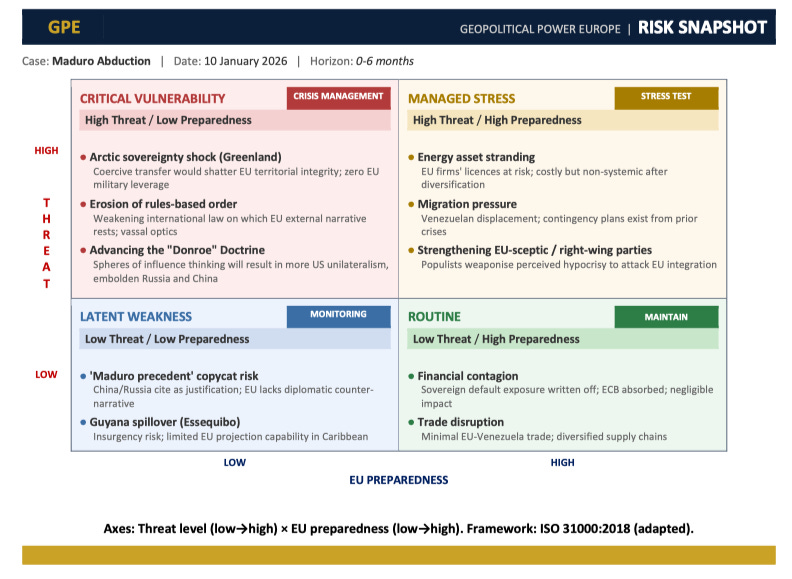
2.1 CRITICAL VULNERABILITY — Crisis Management Required
High Threat / Low Preparedness
Arctic sovereignty shock (Greenland): Trump’s renewed interest in Greenland acquisition, combined with sphere-of-influence logic normalised by the Maduro operation, creates the EU’s most severe territorial vulnerability. Denmark lacks independent military capacity to deter coercion; EU instruments are untested. No EU doctrine exists for defending associated territory against pressure from its primary security guarantor. A coercive transfer would shatter territorial integrity.
Erosion of rules-based order: The operation directly challenges the legal framework on which EU external action rests. Failure to articulate a clear position risks ‘vassal’ optics in the Global South and undermines the EU’s normative differentiation from great-power competitors.
Advancing the “Donroe” Doctrine: Spheres of influence thinking will result in more US unilateralism, embolden Russia and China to pursue similar approaches in their claimed regions of influence.
Policy implication: Treat as sovereignty-and-alliance dilemma. Develop Greenland contingency playbook; support Denmark.
2.2 MANAGED STRESS — Stress Testing Required
High Threat / High Preparedness
Energy asset stranding: Repsol and Eni hold significant Venezuelan upstream positions. US-managed transition may favour American firms. However, post-Russia diversification limits systemic exposure.
Migration pressure: 7.7 million Venezuelans displaced since 2015. Venezuelan displacement could accelerate. EU contingency frameworks exist from prior crises but require activation readiness. Europe has tools but burden-sharing remains contested.
Strengthening EU-sceptic / right-wing parties: Populists may weaponise perceived hypocrisy to attack EU integration and rules-based order narratives.
Policy implication: Run stress tests on energy exposure, migration contingency, law-enforcement coordination. Avoid maximalist overreaction.
2.3 LATENT WEAKNESS — Monitoring Required
Low Threat / Low Preparedness
‘Maduro precedent’ copycat risk: If an ally can abduct a sitting head of state, the EU’s rules-based narrative becomes dismissible as selective—weakening arguments vis-à-vis Russia and China. [12] China and Russia may cite the operation as justification for similar actions in their claimed spheres. EU lacks prepared diplomatic counter-narrative.
Guyana spillover (Essequibo): Territorial dispute may reignite under instability. Limited EU projection capability in Caribbean basin.
EU-Mercosur ratification at risk: Latin American backlash complicates ratification; partners question EU reliability on sovereignty.
Policy implication: Invest in narrative resilience (consistent legal framing), neighbourhood deterrence signalling, guidance for firms under legal uncertainty.
2.4 ROUTINE — Maintain Current Protocols
Low Threat / High Preparedness
Financial contagion: Sovereign default exposure written off; ECB absorbed; negligible systemic impact.
Trade disruption: Minimal EU-Venezuela bilateral trade; diversified supply chains limit exposure.
Policy implication: Maintain contingency plans; coordinate consular planning; publish consistent ‘principles paragraph’ for messaging.
3. Risk Cascade and Multiplier Effects
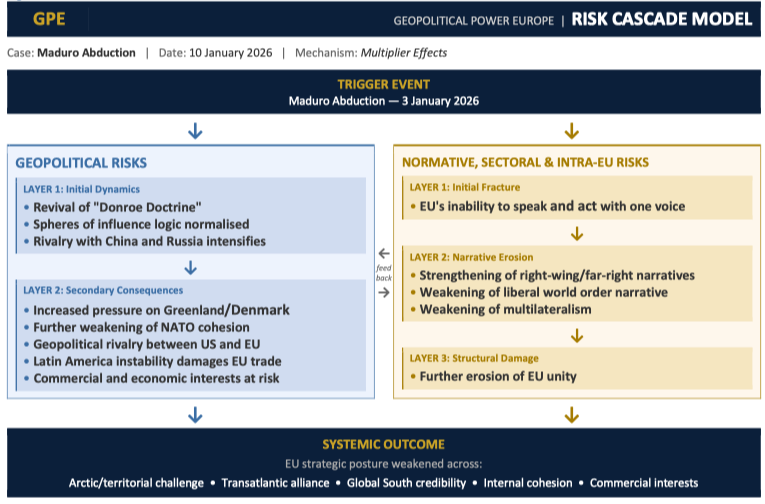
The Maduro abduction should not be analysed as a single event with discrete consequences. Rather, it functions as a trigger event that activates interconnected risk pathways across geopolitical, normative, and intra-EU dimensions (Figure 1). These risks do not operate in isolation—they act as multipliers, each reinforcing the others through feedback loops that can amplify the overall impact far beyond the sum of individual parts.
Figure 2: GPE Risk Cascade Model
MULTIPLIER EFFECT
Risks reinforce each other through feedback loops. Geopolitical pressure on Greenland amplifies intra-EU divisions; EU fragmentation emboldens further US unilateralism. Systemic resilience required—not issue-by-issue firefighting.
3.1 Geopolitical Risk Cascade
The geopolitical pathway runs: Donroe Doctrine normalises spheres-of-influence logic → emboldens Greenland pressure → strains NATO cohesion → triggers US-EU competition in third regions → undermines EU actorness. Each link in this chain is identified in Section 2’s threat matrix; the cascade model shows how they connect sequentially.
3.2 Normative, Sectoral, and Intra-EU Risk Cascade
The normative pathway runs: EU fragmented response → right-wing narratives exploit ‘double standards’ → liberal order credibility erodes → multilateral institutions weakened → further EU disunity. Energy firms face uncertainty as US-managed transitions may favour American commercial interests.
3.3 The Multiplier Effect: Feedback Loops
Critically, these two cascades interact and reinforce each other (Figure 1). This is not a linear risk chain but a feedback system where interventions at one node can either dampen or amplify effects throughout:
Geopolitical pressure on Greenland amplifies intra-EU divisions (Nordic states vs southern members with different threat perceptions).
EU fragmentation emboldens further US unilateralism, as Washington perceives Europe as a weak and divided actor.
Right-wing exploitation of ‘double standards’ weakens the EU’s capacity to mount a coherent response to Greenland pressure.
Weakened EU credibility in the Global South damages trade negotiations and climate partnerships, which feeds back into domestic Eurosceptic narratives about EU ineffectiveness.
Implication: Risk assessment must account for interaction effects. A narrow focus on ‘Venezuela policy’ misses how the episode reshapes the entire strategic environment. The EU needs systemic resilience, not issue-by-issue firefighting.
4. Scenario Analysis
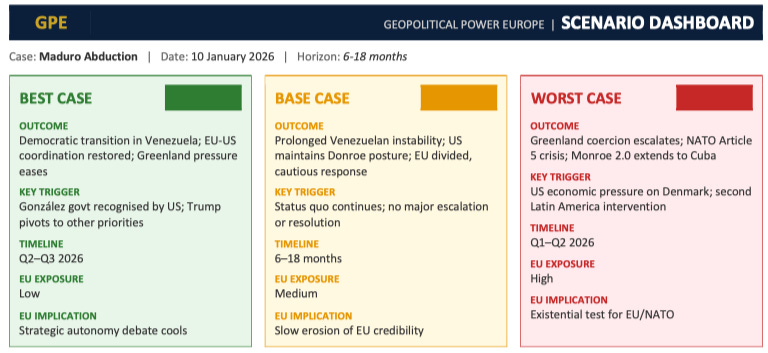
Three scenarios over a 6–18 month horizon, weighted by current trajectory analysis:
Figure 3: GPE Scenario Dashboard
ASSESSMENT
Base case most likely, but worst case probability elevated. Greenland remains the key vulnerability—where EU strategic autonomy rhetoric meets its hardest test. Early intervention in geopolitical or normative cascades offers the best opportunity to prevent escalation.
5. What to Watch

BOTTOM LINE
The Maduro abduction is a stress test of Europe’s claim to be a geopolitical actor grounded in law. The critical vulnerability is not Venezuela itself—it is Greenland, where sphere-of-influence logic meets EU territorial interests. Risks cascade through interconnected channels, operating as multipliers rather than discrete challenges. Effective response requires clearer legal stance articulation, proactive Latin American diplomatic engagement, Arctic contingency protocols, and systemic resilience across risk categories.
About the Author:
Dr. Bidzina Lebanidze is a Senior Geopolitical Risk Strategist and Head of the Jena-Cauc Project at the University of Jena. He holds a Doctorate in Political Science from the Freie Universität Berlin (Germany). His professional career spans over 15 years, characterized by a unique standing at the intersection of high-level policy advisory and academic research.
Disclaimer:
Claude AI Opus 4.5 was used to assist in generating the figures and risk visualizations in this document. All analytical content and conclusions reflect the author’s independent judgment.
